

With the IRS standard mileage rate reaching 72.5 cents per mile in 2026, the traditional road trip relocation is no longer a cost-effective strategy for the modern enterprise. When calculating the ROI of shipping employee vehicles vs mileage reimbursement, one must consider that long-distance shipping costs often range between $0.60 and $0.95 per mile. For a move exceeding 1,500 miles, the financial discrepancy becomes impossible to ignore, especially as national gas prices average $4.11 per gallon. These rising costs, combined with the inherent risks of long-distance travel, necessitate a more strategic approach to corporate mobility.
You likely understand that your employees' time is a premium asset that shouldn't be exhausted by days of transit and the administrative burden of travel logs. This article will demonstrate why professional logistics offer a superior return on investment through reduced corporate liability and faster onboarding in your new city. We'll provide a clear financial framework to help you transition from outdated reimbursement models to a more sophisticated, dedicated transport solution that prioritizes both safety and your bottom line.
Key Takeaways
- Learn how calculating the ROI of shipping employee vehicles vs mileage reimbursement requires a comprehensive analysis of productivity retention and risk mitigation.
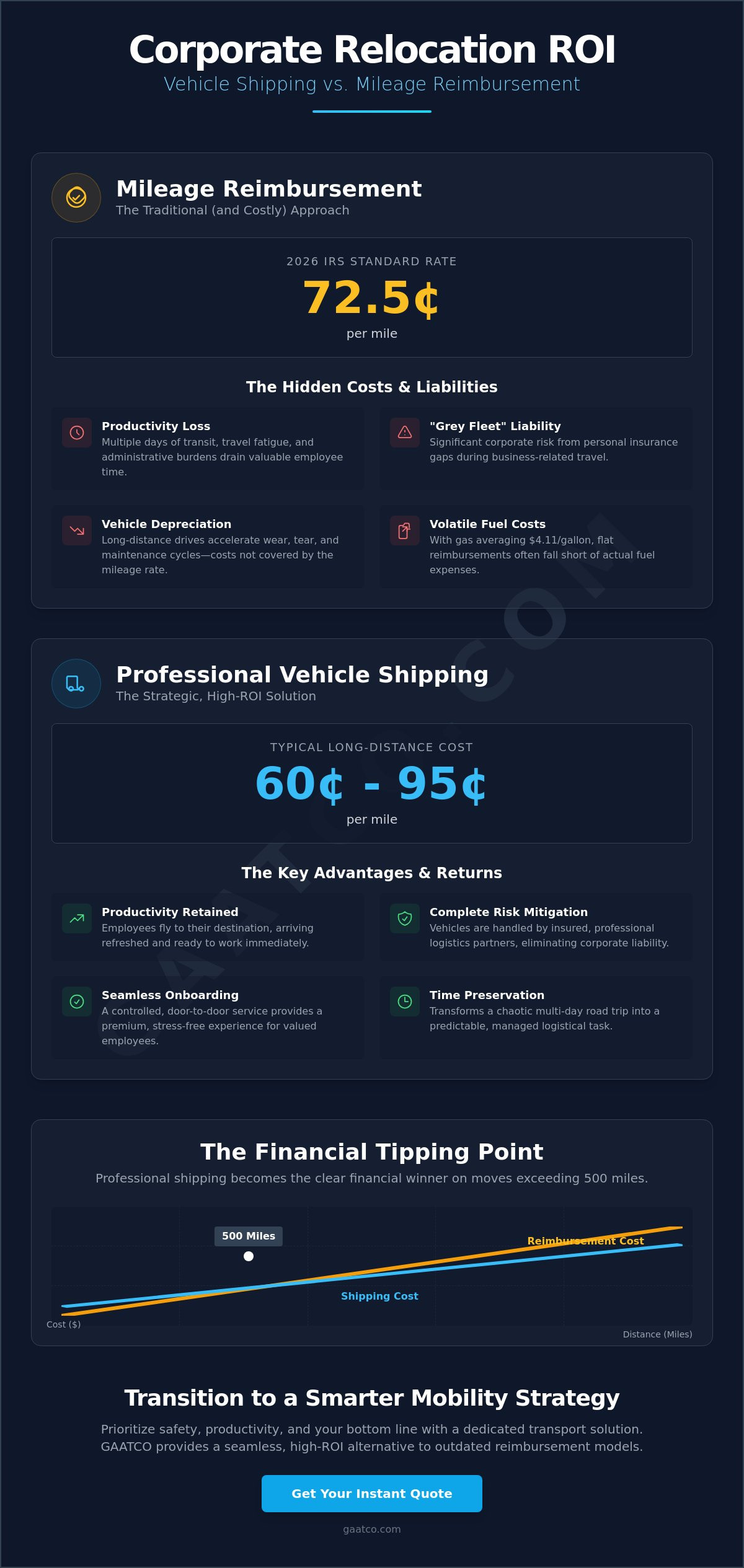
- Identify the critical 500-mile break-even point where professional auto logistics begin to outperform traditional cents-per-mile reimbursement models.
- Examine the "Grey Fleet" dilemma to understand how personal insurance gaps can create significant liability exposure for your organization during a relocation.
- Discover why high-traffic corridors like the NYC-to-Miami executive pipeline demand bespoke shipping solutions to maintain corporate standards and schedule integrity.
- Access a structured framework for integrating premium vehicle transport into your HR onboarding workflow to ensure a seamless transition for your most valued assets.
The 2026 Corporate Mobility Landscape: Shipping vs. Reimbursement
The landscape of corporate relocation in 2026 requires a level of precision that mirrors the high standards of private aviation. As organizations expand their footprints between major economic hubs like Houston and Atlanta, the method of relocating personnel has shifted from a simple administrative task to a complex exercise in risk management. Calculating the ROI of shipping employee vehicles vs mileage reimbursement is now a fundamental requirement for sophisticated HR departments. This calculation defines ROI as the total value recovered through time preservation, the mitigation of road-related hazards, and the immediate availability of the employee at their new destination.
Relying on an employee to drive their personal vehicle across the country is increasingly viewed as a legacy liability. It's an outdated model that prioritizes short-term cash flow over long-term productivity and safety. In a high-stakes corporate environment, the goal is a seamless transition that allows leadership to focus on their new responsibilities without the exhaustion of a multi-day journey. When a professional's time is valued at hundreds of dollars per hour, the cost of a road trip becomes an expensive drain on corporate resources.
To better understand the financial nuances of vehicle management and how these decisions impact the bottom line, watch this helpful video:
The Escalating Cost of Mileage Reimbursement
As of January 2026, the IRS standard mileage rate for business use stands at 72.5 cents per mile. For a relocation spanning 1,000 miles or more, these costs accumulate rapidly. Beyond the flat rate, companies often face hidden fuel surcharges and wear-and-tear costs that employees frequently overlook until the journey is complete. With national gas prices averaging $4.11 per gallon in April 2026, which is a 29.5% increase from the previous year, a flat reimbursement check often becomes a leaky financial strategy. It fails to account for the total cost of ownership or the potential for mechanical failure during a stressful cross-country trek.
Defining the Professional Shipping Alternative
Professional Open Car Transport serves as the reliable baseline for modern ROI comparisons. By choosing a dedicated logistics partner, a company transforms a chaotic road trip into a controlled, door-to-door service. This shift toward bespoke logistics in executive relocation packages provides a significant psychological benefit to the employee. They experience a seamless transition, arriving at their destination via flight while their vehicle is handled by experts. This premium approach ensures that the executive pipeline remains efficient, allowing the team to maintain a steady and measured rhythm during times of transition.
The Hidden Costs of Mileage Reimbursement: Beyond the Cents-Per-Mile
While the 72.5 cents per mile IRS rate provides a baseline for expense, it fails to account for the complex liabilities inherent in the "Grey Fleet." This term refers to personal vehicles used for corporate purposes, a category that suddenly expands during a major relocation. When calculating the ROI of shipping employee vehicles vs mileage reimbursement, a sophisticated organization must look past the immediate check and consider the long-term impact on vehicle health and corporate exposure. A 2,000-mile cross-country journey accelerates depreciation and brings forward expensive maintenance cycles that are rarely captured in a standard reimbursement model.
Insurance gaps represent a significant, often invisible, risk for the modern enterprise. Most personal auto insurance policies contain specific exclusions for business-related travel or may fail to provide adequate coverage during a professional relocation. In 2026, with commercial auto insurance premiums averaging $1,764 annually due to rising repair costs, the financial stakes of an uninsured incident are higher than ever. Integrating vehicle transport into corporate relocation packages ensures that the vehicle is protected under a professional umbrella rather than a potentially insufficient personal policy.
Liability and Duty of Care in 2026
The legal landscape regarding employee safety has become increasingly stringent. Duty of Care is the legal and moral obligation of an organization to ensure the safety and well-being of its employees while they are performing work-related tasks. Expecting an employee to navigate several days of highway traffic creates an unnecessary safety risk that could lead to significant litigation. This exposure stands in sharp contrast to the licensed and insured protection provided by elite carriers who specialize in secure, long-distance logistics.
Administrative Overhead and Fraud Risk
The burden on HR and accounting departments to verify manual logs for a multi-day trip is a hidden drain on productivity. Auditing expenses for hotels, meals, and fuel across several states requires hours of administrative time that could be better spent on higher-value onboarding tasks. Manual reporting also introduces the risk of mileage padding, a common issue in long-distance claims. Transitioning to a professional shipping strategy simplifies the entire accounting process into a single, transparent invoice. If you're looking to streamline your relocation budget, you might consider how a bespoke shipping quote can eliminate these administrative complexities and provide a fixed, predictable cost for your next executive move.
The ROI Calculation: Shipping vs. Driving Framework
A sophisticated financial analysis reveals that the 500-mile mark represents a critical threshold for corporate relocation. At distances shorter than this, the logistics of transport might seem comparable to personal driving. However, once a journey exceeds 500 miles, the efficiency of professional shipping becomes significantly more pronounced. Calculating the ROI of shipping employee vehicles vs mileage reimbursement involves a comprehensive formula that accounts for both hard expenditures and the subtle, often overlooked, costs of lost time. The true ROI is determined by subtracting the total shipping cost from the sum of mileage reimbursement, hotel stays, meals, and the quantified loss of employee productivity.
When an executive is tasked with a 1,500-mile relocation, the IRS reimbursement alone reaches $1,087.50 based on the 72.5 cents per mile rate. This figure does not include the three days of lodging and dining required for a safe journey. In contrast, long-distance shipping rates in 2026 often range between $0.60 and $0.95 per mile, making the base cost of transport competitive even before factoring in the employee's hourly value. For those relocating high-value assets, Enclosed Car Transport provides an additional layer of security that further tips the ROI in favor of professional logistics by eliminating the risk of road debris and weather damage.
Measuring Productivity Retention
The most significant variable in this calculation is the opportunity cost of the employee's time. A drive from Dallas to Seattle involves roughly 32 hours of active transit, effectively removing a key contributor from the grid for nearly a full work week. By choosing a professional carrier, the employee can instead utilize a four-hour flight to remain engaged with their team. This creates a "Day Zero" advantage, where the individual arrives in the new city refreshed and ready to lead rather than exhausted from days on the road. For critical projects in hubs like San Diego or Seattle, this preserved momentum can be the difference between meeting a deadline and facing a costly delay.
The Depreciation Factor
Vehicle depreciation in the 2026 market is a harsh reality for employees. Adding 1,500 miles to an odometer in a single week can decrease a vehicle's resale value by hundreds of dollars, a "soft cost" that the employee ultimately bears. Shipping preserves the asset's condition and mileage, which significantly increases overall employee satisfaction and reinforces the company's image as a dedicated partner. While a shipping quote is a visible line item, the invisible cost of vehicle aging and the potential for mid-trip mechanical failure represent a financial risk that no modern HR policy should ignore.
Strategic Route Analysis: ROI in Major Corporate Hubs
The financial efficacy of a relocation strategy is often dictated by the specific geography of the transit corridor. When calculating the ROI of shipping employee vehicles vs mileage reimbursement, regional variables like local fuel spikes and seasonal weather patterns become the primary drivers of the final balance sheet. For instance, the Houston-to-Chicago corridor presents unique challenges, including volatile fuel pricing across the Midwest and unpredictable storm systems that can derail a multi-day drive. While fuel in Oklahoma averaged $3.44 per gallon in May 2026, costs rise significantly as an employee nears the Great Lakes, eroding the value of a flat-rate reimbursement.
The NYC-to-Miami "Executive Pipeline" represents another scenario where professional logistics is the preferred standard. This high-traffic route along the I-95 corridor is notorious for congestion and increased accident rates, which significantly elevates the corporate liability for a driving employee. For West Coast transitions involving San Francisco, Seattle, or Phoenix, the ROI shifts even more dramatically. With California fuel prices reaching an average of $5.88 per gallon in 2026, the cost of driving a personal vehicle often exceeds the price of a dedicated transport slot before lodging is even considered.
Regional Cost Variables
Local economic conditions create a fragmented landscape for reimbursement budgets. In San Diego, where gas prices are among the highest in the nation, a standard mileage check rarely covers the true out-of-pocket costs for an employee. Seasonal demand also plays a role; a route from Nashville to Denver may see price fluctuations based on winter weather access. We utilize back-haul optimization and a sophisticated global network to maintain price stability, offering a more predictable expenditure than the "pay-as-you-go" nature of road travel.
Safety and Terrain Considerations
The ROI of shipping includes the avoidance of high-risk terrain, such as steep mountain passes or the dense, high-friction environments of Boston and Chicago. Professional carriers act as a safety insurance policy, protecting the employee's primary asset from road debris and the physical toll of long-distance transit. Our door-to-door service ensures a seamless arrival, allowing your team to bypass the stress of navigating an unfamiliar city in a tired vehicle. To see how these regional factors influence your specific route, you can request a bespoke transport quote tailored to your corporate hub.
Implementing a High-ROI Shipping Strategy with GAATCO
Transitioning from a fragmented mileage-reimbursement model to a centralized logistics strategy requires a deliberate shift in corporate policy. When calculating the ROI of shipping employee vehicles vs mileage reimbursement, the final advantage is found in the simplicity and predictability of the process. Instead of managing dozens of individual expense reports and auditing varied fuel receipts, HR departments can integrate a streamlined solution into their onboarding workflow. This transition replaces the unpredictability of road travel with a fixed, professional standard that reflects the company's commitment to its personnel. It's a move toward financial transparency that eliminates the "leaky" expenses often associated with long-distance driving.
Integrating a Requesting a Quote step directly into the employee relocation portal allows for immediate budget clarity. This digital integration ensures that logistics are handled early in the transition, preventing the last-minute stress that often accompanies long-distance moves. For organizations managing multi-vehicle moves or executive fleet relocations, having a dedicated partner ensures that every asset is tracked and protected with the same rigor applied to private aviation logistics. We provide a single, comprehensive invoice that simplifies the accounting cycle and provides a clear audit trail for the entire relocation process.
Customizing the Relocation Package
A bespoke approach allows companies to offer Open vs. Enclosed Transport based on specific employee tiers or vehicle values. High-level executives with premium assets often require the discreet protection of an enclosed trailer to ensure their property arrives in pristine condition. In 2026, setting clear expectations for pickup and delivery windows is essential for a smooth transition. Our 20 years of experience provides the operational maturity required to handle these nuances, ensuring that your team experiences a hassle-free arrival. We focus on the details of the transport so your employees don't have to, maintaining a steady and measured rhythm throughout the move.
The Future of Corporate Mobility
As we look toward 2027, we predict a definitive shift toward fully outsourced vehicle logistics as the standard for the modern enterprise. The administrative burden and liability risks of the "Grey Fleet" are becoming too significant for sophisticated organizations to justify. GAATCO remains the dependable choice for organizations that value safety and excellence as non-negotiable pillars of their mobility strategy. We act as a trusted advisor, handling the complexities of ground transport so your leadership can focus on the mission ahead. If you're ready to elevate your mobility strategy and secure a superior return on your relocation investment, consult with GAATCO for your next corporate relocation.
Elevating Your Corporate Mobility Standards
The shift toward professional logistics is a strategic investment in your organization's long-term efficiency. When you're calculating the ROI of shipping employee vehicles vs mileage reimbursement, it's clear that the advantages of productivity retention and risk mitigation far outweigh the simple 72.5 cents per mile calculation. Preserving an executive's energy and focus during a high-stakes relocation ensures they're ready to lead from day one. This transition moves your company away from the legacy liabilities of the "Grey Fleet" and toward a model of safety and financial transparency.
GAATCO provides 20+ years of industry expertise and a dedicated network of licensed and insured carriers to manage these complex transitions. We offer specialized door-to-door solutions across 15+ major US hubs, ensuring a seamless experience that mirrors the high standards of private aviation. It's time to replace the administrative burden of manual travel logs with the predictable clarity of a single, professional invoice. We handle the complexities of your ground logistics so you don't have to.
Request a Bespoke Corporate Shipping Quote to streamline your next executive move. We look forward to serving as your trusted advisor in global mobility.
Frequently Asked Questions
Is shipping a vehicle tax-deductible for corporations in 2026?
Shipping is generally considered a deductible business expense under current 2026 tax codes when it forms part of a necessary corporate relocation. While the Tax Cuts and Jobs Act previously altered individual moving deductions, corporations can still deduct the costs of transporting assets as part of their operational expenditures. We recommend consulting with your tax advisor to confirm the specific treatment for your organization's unique structure.
What is the break-even mileage where shipping becomes cheaper than reimbursement?
The break-even point typically occurs at the 500-mile mark. Beyond this distance, the cumulative costs of the 72.5 cents per mile IRS rate, lodging, and productivity loss begin to exceed the cost of professional transport. When calculating the ROI of shipping employee vehicles vs mileage reimbursement for distances over 1,000 miles, the financial advantage of shipping becomes even more pronounced due to reduced administrative overhead.
How does the 2026 IRS mileage rate compare to standard shipping fees?
The 2026 IRS business mileage rate is fixed at 72.5 cents per mile, while long-distance shipping rates generally range from $0.60 to $0.95 per mile. Although the per-mile cost of shipping can occasionally be higher, it effectively eliminates the soft costs of meals, hotels, and the risk of accidents. This makes shipping a more predictable and often more economical choice for cross-country logistics.
Can we ship multiple employee vehicles at once to save on costs?
Multi-vehicle transport provides significant cost efficiencies for organizations relocating entire teams or departments. By consolidating several vehicles onto a single carrier, we can optimize routes and reduce the per-unit cost for the company. This approach also simplifies the logistics of the move, as all employee assets arrive within a synchronized window, ensuring a seamless start for the whole team.
What happens if an employee’s vehicle is damaged during driving vs. shipping?
Damage during a personal drive is typically covered by the employee's personal insurance, which can lead to significant liability gaps for the employer. In contrast, professional carriers are required to carry substantial insurance policies that protect the vehicle during transit. This shifts the risk away from the corporate balance sheet and provides a dedicated layer of protection for the employee's asset.
How long does it typically take to ship a car from Dallas to New York?
Transit from Dallas to New York, a journey of approximately 1,550 miles, typically requires three to five days for delivery. This timeframe is often shorter than a solo drive when accounting for the mandatory rest periods required for a safe journey. Our logistics team provides precise tracking to ensure your team can plan their arrival with confidence and precision.
Does GAATCO offer expedited shipping for urgent corporate transfers?
We provide expedited shipping solutions tailored to the urgent needs of our corporate clients. These bespoke services prioritize your vehicles for immediate pickup and direct transit, mirroring the efficiency of a private charter flight. While standard windows are reliable, our expedited options ensure that critical personnel have their vehicles available immediately upon their arrival in the new city.
Is there a difference in ROI between open and enclosed carrier transport?
The difference in ROI between open and enclosed transport depends largely on the vehicle's market value. For standard fleet vehicles, open transport offers a high return through lower initial costs. However, for high-value or luxury assets, the premium for enclosed transport is justified by the total elimination of road debris and weather risks. Enclosed shipping preserves the asset's condition, which is a vital part of calculating the ROI of shipping employee vehicles vs mileage reimbursement for executive-level moves.


