
The lowest quote for your vehicle shipment is often the most expensive mistake you'll make. While many owners focus on the immediate price, the true distinction lies in the architecture of the logistics partnership you establish. Understanding the auto transport broker vs carrier pros and cons isn't merely about finding a route; it's about securing a bespoke service that guarantees accountability. With the national average for diesel forecasted at $4.80 per gallon for the full year 2026, and a total fuel surcharge rate of 14.00% currently in effect, managing these shifting variables requires a level of expertise that goes beyond a simple transaction.
You likely seek a seamless journey for your vehicle, free from the anxiety of hidden fees or the frustration of fragmented communication. This analysis provides a professional comparison of the two primary shipping models to ensure your shipment arrives damage-free and precisely on schedule. We'll examine the implications of the January 2026 FMCSA financial security regulations, the transition to USDOT identifiers, and how these factors influence your choice between direct carrier access and the comprehensive reach of a professional broker.
Key Takeaways
- Identify the distinct roles of logistics managers and fleet operators to determine which model best supports your security and timing requirements.
- Evaluate the auto transport broker vs carrier pros and cons to secure transparent pricing and avoid the common pitfalls of unvetted transport networks.
- Apply a strategic framework for high-value assets to ensure that luxury or classic vehicles receive the specialized care they demand.
- Discover how a single professional point of contact eliminates communication gaps and ensures your vehicle's safety throughout its journey.
Understanding the Auto Transport Ecosystem: Brokers vs. Carriers
The logistics industry is built on a foundation of specialized roles. For many vehicle owners, Understanding the Auto Transport Ecosystem is the first step toward a successful delivery. An auto transport broker acts as a licensed logistics professional who oversees the entire lifecycle of a shipment, from the initial consultation to final delivery confirmation. They don't own trucks; instead, they manage the intricate details that keep the supply chain moving with precision.
Conversely, a carrier is the physical entity that owns the fleet and performs the actual haul. In 2026, the industry has undergone a structural reset, making it vital to weigh the auto transport broker vs carrier pros and cons before committing to a provider. First-time shippers often view this as a binary choice, yet the most secure transport experiences usually involve a broker managing a high-performing carrier. This collaboration ensures that the logistical complexities don't interfere with the physical safety of the vehicle.
To better understand this concept, watch this helpful video:
The Role of the Broker: Logistics Coordination
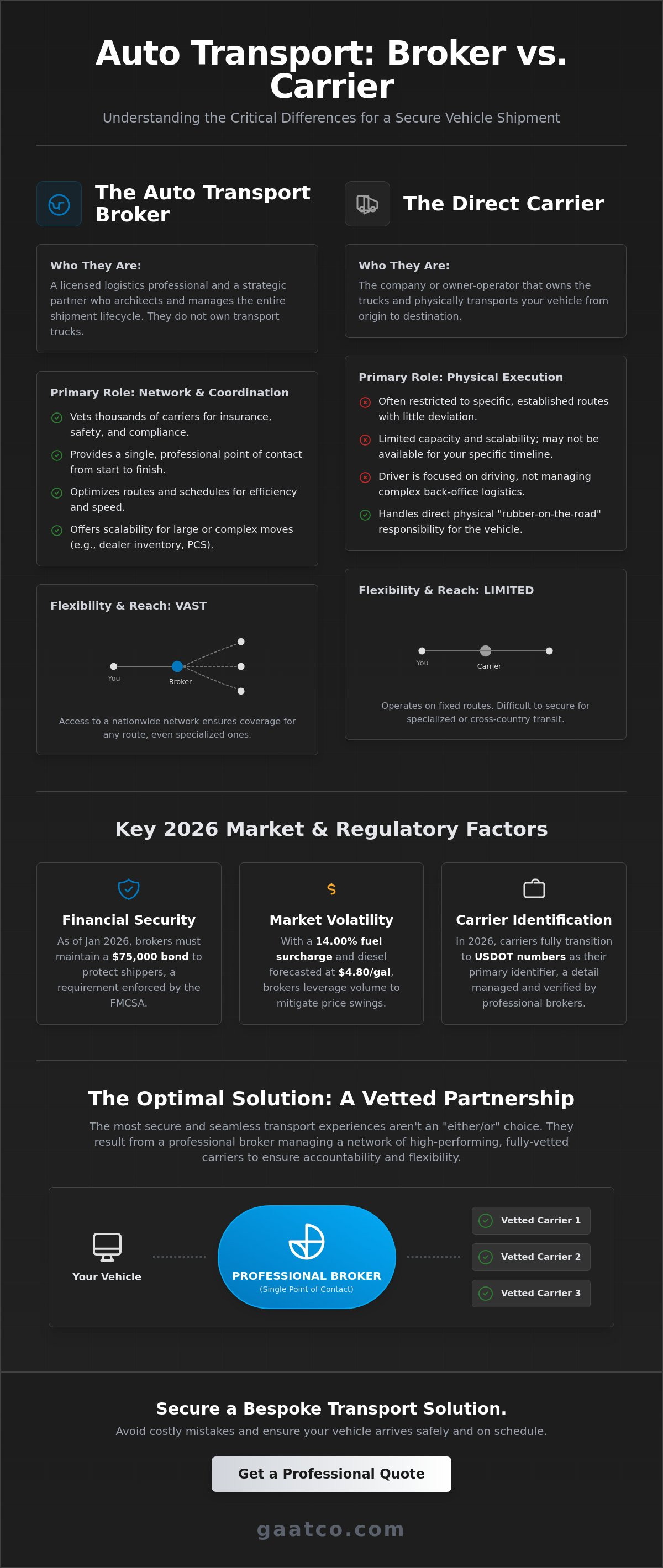
Brokers serve as the sophisticated architects of your vehicle's journey. Their primary responsibility involves vetting carriers for insurance compliance and safety ratings. As of January 16, 2026, brokers must maintain a $75,000 bond or trust fund to remain compliant with FMCSA regulations. This financial security ensures that shippers are protected throughout the process. For clients in dense hubs like New York or Chicago, a broker acts as a dedicated advisor, managing the complex back-office tasks of route optimization and scheduling that a driver simply cannot handle while on the road.
The Role of the Carrier: Physical Execution
The carrier holds direct responsibility for the vehicle during the 'rubber-on-the-road' phase. These entities range from individual owner-operators to large commercial fleets. While they provide the physical labor, small-fleet carriers often lack the flexibility to deviate from established routes. This makes direct carriers difficult to secure for specialized paths, such as a Seattle to Miami transit, without the assistance of a broker's extensive network. Carriers are also currently transitioning to using USDOT numbers as their primary identifier, a change finalized in early 2026 to simplify identification and reduce fraud.
Choosing between these entities requires an understanding of how they interact within the modern supply chain. A broker provides the bespoke planning required for high-stakes transport, while the carrier provides the machinery. Navigating the auto transport broker vs carrier pros and cons allows you to select a partner who understands the nuances of 2026 logistics, particularly for specialized needs like enclosed car transport where precision is a non-negotiable pillar of excellence.
The Auto Transport Broker: Network, Flexibility, and Market Reach
The decision to engage a broker is often a choice to prioritize flexibility and comprehensive oversight. When evaluating the auto transport broker vs carrier pros and cons, the most significant advantage of the broker model is the access it provides to a vast, pre-vetted network of thousands of specialized carriers. This infrastructure is essential for complex logistics, such as large dealer-to-dealer inventory transfers or military PCS transitions. A broker offers a level of scalability that a single-fleet carrier cannot match. By operating as a central hub, the broker manages the entire shipment lifecycle, providing a layer of quiet luxury that allows the client to remain focused on their own priorities while every friction point is handled with professional discretion.
A potential drawback involves the variation in initial quotes versus final dispatch prices. In May 2026, the industry is navigating a total fuel surcharge rate of 14.00%, which can cause market rates to shift quickly. Professional brokers mitigate this by maintaining transparent communication and leveraging their volume to secure stable pricing. This meticulous attention to detail ensures that the client isn't surprised by costs during the final stages of the journey. A thorough understanding of the auto transport broker vs carrier pros and cons helps clients avoid the volatility of the open market.
Why Network Depth Matters for 2026 Logistics
Securing a specialized enclosed carrier in competitive markets like San Diego or Austin requires established industry relationships. Brokers utilize advanced logistics technology to ensure your vehicle is prioritized, preventing it from sitting in a holding lot for weeks. Market reach is the ability to find a carrier for any vehicle type on any route. This capability is critical in 2026, as the national average for diesel is forecasted at $4.80 per gallon, making route efficiency vital for maintaining schedule integrity.
Managing the 'Middleman' Stigma
It's vital to differentiate between lead generators and licensed professionals. Lead generators merely sell your data, whereas a licensed broker manages your move from inception to completion. When Evaluating Your Priorities: A Framework for High-Value Vehicle Logistics, the value of a single point of contact becomes clear. Shipping cross-country from Boston to Las Vegas involves numerous variables. A professional broker absorbs the stress of these fluctuations, ensuring a seamless experience. If you require a bespoke solution, you may Explore our comprehensive transport services to see how we maintain excellence across every mile.
The Direct Carrier: Accountability, Communication, and Fleet Control
Engaging directly with a carrier offers a sense of proximity to the physical operation that many find reassuring. When evaluating the auto transport broker vs carrier pros and cons, the most prominent benefit is the direct line of communication with the driver or fleet dispatcher. You aren't speaking to a logistics agent; you're speaking to the professional who'll physically handle your vehicle. This eliminates potential miscommunications and creates a linear path of accountability. The entity receiving your payment is the same one responsible for the safety of your asset, which simplifies the process for those who prefer a single point of contact.
Direct carriers often provide precise control over pickup and delivery windows, especially for expedited shipments. Because they manage their own schedules without external coordination, they can often commit to tighter timelines on specific corridors. However, this model's effectiveness is frequently limited by geographic coverage. Most carriers operate within fixed regional loops. Finding a direct carrier that spans the entire country with the same level of consistency as a managed network is often difficult for individual shippers.
Direct Communication and Real-Time Updates
The intimacy of the carrier-client relationship is most evident during the physical transport phase. Speaking directly to the professional handling your luxury vehicle provides an immediate sense of security. These drivers manage the Bill of Lading (BOL) and inspection reports personally, ensuring that every detail is documented with the owner present. This level of transparency is particularly effective for local routes within expansive states like Texas or California. While Navigating the Choice with GAATCO involves understanding these nuances, the direct model remains a viable option for those who prefer hands-on fleet control.
The Risks of Limited Fleet Capacity
The primary vulnerability of the direct carrier model is its inherent lack of redundancy. If a carrier's only truck suffers a mechanical failure in Denver or Phoenix, the shipment typically stops until repairs are completed. Unlike a brokered network that can quickly dispatch a secondary unit, a direct carrier often lacks backup options. This risk is heightened in 2026 due to stricter Electronic Logging Device (ELD) compliance rules effective February 7, 2026. Carriers using revoked ELDs now face immediate out-of-service orders, which can strand a vehicle indefinitely. It's also imperative to verify that the carrier maintains specific insurance for high-value enclosed car transport, as standard policies might not cover the full replacement value of a bespoke or classic vehicle.
Evaluating Your Priorities: A Framework for High-Value Vehicle Logistics
Selecting the ideal logistics partner involves more than a cursory glance at a quote. It requires a strategic assessment of your primary objectives. Are you prioritizing the lowest possible expenditure, the most aggressive delivery schedule, or the absolute maximum level of security for a rare asset? When analyzing the auto transport broker vs carrier pros and cons, the decision often hinges on the specific profile of the cargo. High-value vehicle logistics demand a "Vehicle Value" rule. If a vehicle's market value exceeds $100,000, the standard logistics model must shift toward a dedicated, enclosed solution that prioritizes climate control and specialized handling equipment.
Route complexity also dictates the necessary level of oversight. A simple hub-to-hub transit, such as Dallas to Houston, involves predictable variables and high carrier density. Conversely, shipping to a remote location requires a broker's ability to coordinate "last-mile" logistics where standard carriers don't frequently operate. Regardless of the route, verifying operating authority remains mandatory. Even with the 2026 transition to USDOT numbers as the primary identifier, you must ensure your provider's status is active and their safety ratings are exemplary before releasing your keys.
Decision Matrix: Broker vs. Carrier for 2026
The optimal choice varies based on the vehicle type and the urgency of the move. For a daily driver, an open carrier found through a direct search might suffice for cost-conscious owners. However, classic car owners and military personnel undergoing a PCS transition often require the broader reach of a broker to navigate strict base protocols or find specialized trailers. Expedited shipping surcharges are handled differently across these models. Carriers typically charge for the disruption of their existing schedule, while brokers leverage their network to find a driver already positioned for an immediate pickup. We define bespoke logistics as a service tailored to the specific mechanical needs of the vehicle, ensuring that low-clearance exotics or inoperable vintage models receive appropriate equipment.
Insurance Vetting: The Non-Negotiable Pillar
Insurance remains the most critical point of failure in amateur logistics. You must verify that a carrier's cargo insurance covers the full market value of your vehicle, not just a generic per-pound rate. Many standard carriers maintain limits that are insufficient for premium assets. A professional broker adds value here by providing contingent cargo insurance. This secondary policy acts as a safety net if the carrier's primary coverage is denied or found to be expired at the time of an incident. This dual-layered protection is a hallmark of elite transport services. To ensure your asset is protected by a meticulously vetted network, you should Request a professional transport quote from a partner who understands these high-stakes requirements.
Securing a damage-free delivery requires a commitment to these vetting standards. Whether you choose the direct control of a carrier or the comprehensive management of a broker, transparency in insurance and authority is the only way to guarantee a seamless experience. If you value a single, professional point of contact for the entire journey, a managed logistics approach provides the most reliable path forward. You can visit our homepage to learn more about our commitment to excellence in vehicle transport.
Navigating the Choice with GAATCO: 20 Years of Reliable Logistics
The selection of a transport partner is a decision of significant consequence. It requires a partner who possesses both the reach of a global network and the meticulous attention to detail typically found in private aviation. GAATCO has established itself as a premium provider over more than two decades, offering an authoritative approach to vehicle logistics. By understanding the auto transport broker vs carrier pros and cons, we've developed a model that bridges the gap between the flexibility of a broker and the rigid accountability of a carrier. We don't merely facilitate moves; we architect secure journeys for high-value assets across the nation.
Our commitment to excellence is reflected in our transparent pricing structure. Navigating the auto transport broker vs carrier pros and cons involves more than comparing initial quotes; it requires a commitment to safety and excellence as non-negotiable pillars. In an industry where unexpected fees are a common grievance, we provide a single, professional point of contact for the entire duration of the shipment. This approach ensures that technical details regarding fuel surcharges or carrier vetting are handled by experts, leaving our clients to enjoy a seamless experience. We maintain a unified team of professionals who operate behind the sophisticated machinery of our network to deliver your vehicle on time and in pristine condition.
The GAATCO Standard for Open and Enclosed Transport
Whether you require open car transport for a daily driver or enclosed car transport for a bespoke exotic, our standards remain uncompromising. Our fees are inclusive of comprehensive insurance and the current 14.00% fuel surcharge rate for May 2026. We utilize specialized handling protocols for classic car transport, ensuring that every vehicle is treated with the reverence it deserves. Our door-to-door solutions eliminate the logistical friction of terminal drops, providing a truly hassle-free relocation for military personnel and corporate clients alike. Every step is managed with a calm confidence that comes from established expertise in this specialized field.
Seamless Logistics from Coast to Coast
We maintain a strategic presence in key markets including Atlanta, Nashville, and San Francisco. This global reach, combined with local expertise, allows us to serve major hubs from Seattle to Orlando with absolute precision. Our human-centric approach means you'll always have access to a dedicated advisor who understands the nuances of your specific route and vehicle type. We handle the complexities of the road so the client does not have to. For those who seek a discreet and dependable partner, Contact GAATCO today for a bespoke shipping solution that prioritizes the safety of your investment above all else.
Securing the Future of Your Vehicle Logistics
The evolution of the transport industry in 2026 demands a sophisticated approach to vehicle relocation. We've explored the auto transport broker vs carrier pros and cons, highlighting that the most successful shipments rely on a blend of expansive network reach and unwavering accountability. Whether you're moving a classic investment or a military POV, the priority remains a damage-free delivery supported by rigorous insurance vetting and regulatory compliance. Professionalism is not just a standard; it's a commitment to the safety of your asset.
GAATCO serves as your trusted advisor, bridging the gap between complex logistics and the physical reality of the road. With over 20 years of industry experience and a meticulously vetted, fully insured carrier network, we ensure that your luxury or specialized vehicle receives the premium care it requires. Our team handles the intricate details of scheduling and safety so you don't have to. We invite you to experience a shipment defined by quiet luxury and professional precision.
Secure your 2026 vehicle shipment with a professional GAATCO quote and ensure your asset arrives with the excellence it deserves.
Frequently Asked Questions
Is it cheaper to book with a carrier or a broker?
Booking directly with a carrier may appear less expensive as it removes the management fee, yet brokers often leverage high-volume relationships to secure more competitive rates than an individual could obtain. When evaluating the auto transport broker vs carrier pros and cons, consider that a broker's ability to find backhaul routes can offset their service fee. In May 2026, the total expenditure is also heavily influenced by the 14.00% fuel surcharge, making route efficiency more important than just the base quote.
Can a broker guarantee a specific delivery date?
Most brokers and carriers provide a delivery window rather than a guaranteed date due to the unpredictable variables of long-haul logistics. Factors such as weather, traffic, and strict adherence to Hours-of-Service (HOS) regulations by drivers make precise timing difficult. While expedited services are available for a premium, a professional logistics partner will prioritize a safe, realistic arrival over a high-risk guarantee to ensure the integrity of your vehicle.
What happens if my car is damaged during transport with a broker?
The carrier's cargo insurance serves as the primary coverage for any damage sustained during transit. If you book through a professional broker, they should provide an additional layer of contingent cargo insurance to protect you if the carrier's policy is insufficient or denied. It's vital to ensure the Bill of Lading (BOL) reflects the vehicle's condition at both pickup and delivery to facilitate a seamless claims process with the insurance provider.
How do I verify if an auto transport company is a broker or a carrier?
You can verify a company's status by searching their USDOT number on the Federal Motor Carrier Safety Administration (FMCSA) SAFER website. A carrier will be listed as "Authorized for Hire" with specific fleet data, while a broker is identified as "Broker" under their operating authority. In 2026, the industry has transitioned to using USDOT numbers as the primary identifier to reduce fraud and simplify this verification process for consumers.
Why do brokers require a deposit before the car is picked up?
A deposit typically represents the broker's service fee and confirms your commitment to the shipment. This payment allows the broker to finalize the contract with a specific carrier and lock in your pickup window. Most professional brokers don't process this payment until a carrier is officially dispatched to your location, ensuring that your funds are only utilized once the logistical arrangements are firmly in place.
Can I ship personal items inside my car when using a carrier?
Carriers generally discourage shipping personal items inside a vehicle because their cargo insurance does not cover household goods. Additionally, excessive weight can lead to DOT fines at weigh stations or mechanical strain on the transport trailer. If a carrier allows items, they are typically limited to 100 pounds and must be kept below the window line to ensure the driver's visibility and safety aren't compromised during the journey.
How has the auto transport industry changed in 2026?
The industry has undergone a structural reset in 2026 characterized by stricter financial requirements and digital transparency. As of January 16, 2026, brokers must maintain a $75,000 bond to ensure carrier payment and consumer protection. The mandatory transition to USDOT numbers as the sole identifier and the immediate enforcement of ELD compliance have significantly improved the safety and reliability of the national transport network.
What is an MC number and why does it matter for my shipment?
An MC number historically identified a carrier's authority to operate across state lines. While it was a critical metric for assessing the auto transport broker vs carrier pros and cons, the FMCSA is phasing out MC numbers in 2026 in favor of USDOT numbers. This shift simplifies the regulatory landscape, making it easier for you to verify that your chosen partner is licensed, insured, and compliant with current federal safety standards.


